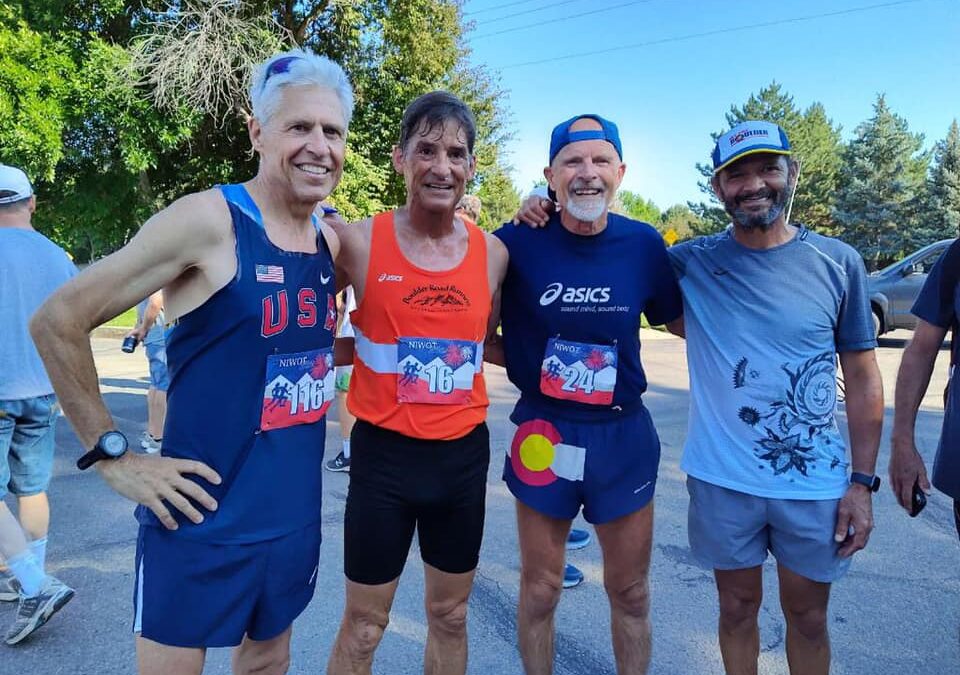
Barros is joined by Dan King, Doug Bell, and Mark Plaatjes at the Niwot Mile 2021.
Long-time BRR member Jeff Barros ran his first race with the club at age 51 in December 2009 at the USA Track & Field (USATF) Masters Grand Prix Club Cross Country National Championships in Lexington, Kentucky. He was there with Doug Bell and finished in 27th place in the 10-kilometer event. Jeff and I first met six years later at the same USATF Masters XC championship held at San Francisco’s Golden Gate Park in 2015. Doug Bell had referred him to me at the last minute because Jeff needed lodging to attend the race. He shared a little motel room on one of the city’s most busy streets with John Victoria and I was quite content to sleep on the couch. Jeff was still in his late 50s then so he did not join our team until he turned 60 in 2017. He has been a key stalwart member of the BRR Men 60-69 team ever since. The words presented in this profile are his. Any editing performed was simply to arrange the narrative in sequence and enhance readability.
From Bruce Kirschner, Photos courtesy of Jeff Barros
Where were you born and where did you grow up?
I was born in Denver, Colorado in 1957 and I grew up in the West Side projects near Colfax Avenue in the poorest part of the city. Then it was low-income housing for people who didn’t have jobs and were on welfare. My family moved each year until we moved to the East Side projects. Back then it was 99 percent Hispanic. People who lived there were in bad circumstances.
Both my parents were Native American. My dad was an Apache from Aguilar, Colorado near Trinidad and my mom was a Jicarilla Apache from the Las Vegas area of northern New Mexico. They had met in Denver. My dad was a laborer and a brick carrier for Denver’s downtown buildings. But his arm was injured in a car accident and could no longer work. He began to drink hard alcohol, like whiskey, became an alcoholic and passed away at age 33 when I was 10 years old. He lived with his grandmother for his last couple of years and she took care of him until he died. My mom had separated from my father when I was 6 years old because he was physically and psychologically abusive to her.
I was the youngest of six children. My older fraternal twins, John and Joan, died at birth. My mother was nearly full-term with the twins, about 9 months pregnant, when she was in a physical fight and got hurt, which caused their deaths in the womb. So I had only two older brothers and a sister.
Without a father to help my family had to live in a survival mode. Mom worked as a seamstress and she took us to her parents when she was working during the day. But they would beat my siblings and I. We would fight back, which they didn’t like. So Mom couldn’t take us there anymore. She would leave us at home alone. My oldest brother would beat and torture us. It was brutal. But we knew how to fight others in the neighborhood…and run too! Eventually Mom abandoned our home and my siblings and I no longer had food. So I ran away from home in the 8th grade and never went back home. I slept under viaducts and in the back seat of cars that I broke into. There was an Italian family that took me in when I was about 13 years old. Then I went to Manual High School near Curtis Park and the East Side projects, which had mostly African American students. When I was a senior I was bused to John F. Kennedy High School as a minority student. I got my girlfriend pregnant in 1974 and we got married when I was in 11th grade. I graduated from high school in 1975.
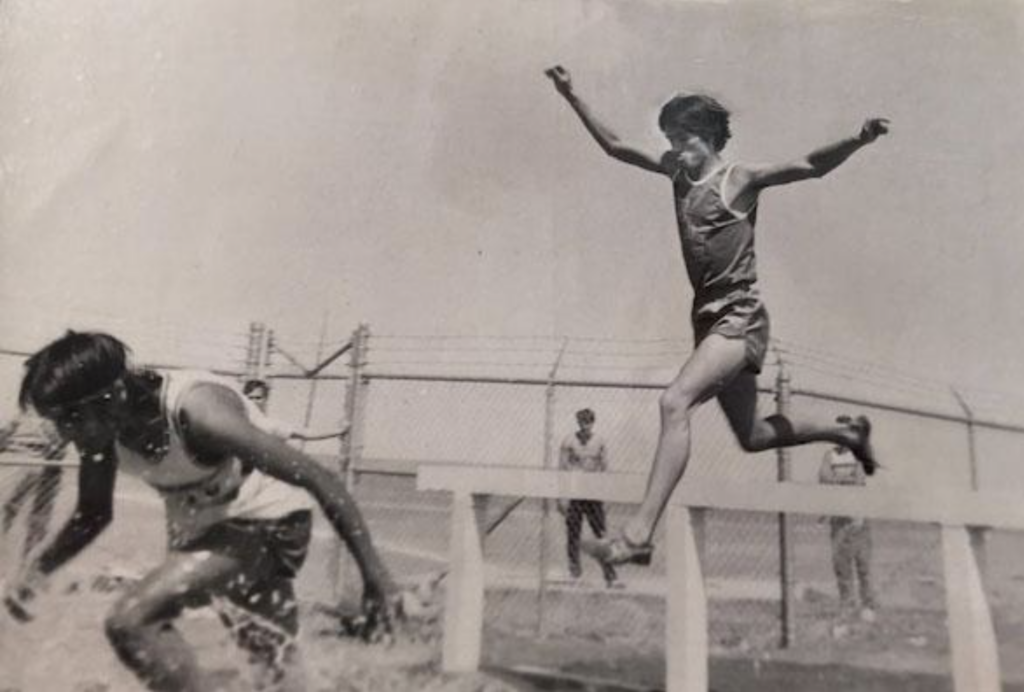
I started attending the University of Northern Colorado after graduating high school. I was a walk on to the college cross country team and the fifth man on team my first semester. I worked two jobs One in the school library after track practice and the other until midnight five nights a week as a dishwasher in the dormitory dining room. I also ran the steeplechase. As a freshman, I was the only member of the team who was willing to race the 5K, 10K and steeplechase all in the same day. I’ll never forget one winter steeplechase race we had in Spearfish, South Dakota. There were hunks of ice floating in the water jump pit!
My second semester I got a track and cross country scholarship for the rest of my college career. It paid my tuition, fees, and books and I no longer had to work two jobs. My wife and I got divorced in 1977.
In 1978 when I was in my junior year a freshman team member from Cincinnati started to pick on me one day because I was a minority. He wanted to fight me. I was stretching and sitting on the ground. I ignored him. He was frustrated because I didn’t respond. Then he kicked me. Had he known that I was a very good fighter he would have never done that. I jumped up to take him on and beat him up pretty easily. Then our new coach came over and said to me, “You want to fight someone, fight me!” That was Doug Bell. He diffused the situation and cooled me down. That was the beginning of a 44-year friendship with Doug. Many years later he invited me to serve on the BRR M60 team. I graduated UNC with a degree in Business Management in 1980.
Where do you live now?
I retired and moved to Thornton last August. Before that I moved around a fair amount. After graduating college I started coaching for the UNC track and cross country team. Then I briefly coached the male and female long-distance runners for the University of New Mexico in Albuquerque. That was followed by a similar graduate assistant coaching position for Texas Tech University in Lubbock, Texas. I continued to live and work in Texas until retiring last August and moving to Thornton. However, this winter has been too cold for me so I’m now planning on living in El Paso during the winter.
What did you do for a living/professionally?
The first 30 years of my career I worked many jobs from janitor to serving as a purchasing agent for General Motors in El Paso. I would buy auto parts made throughout the world that would be assembled in Mexico and sent to GM plants all over the U.S. In 2001 I became a full-time Socorro High School “Bulldogs” girls and boys track and cross country coach and taught financial literacy there for the previous 20 years before I retired in 2021.
Tell us a little about your immediate family.
My oldest daughter from my first marriage lives in New Jersey and serves as an executive for a German-based import/export company. When I was at Texas Tech I started dating one of the women on the team, Maria Medina. She was a miler and the first NCAA All-American from Texas Tech in cross country. We got married in 1984. We had a son and daughter together.
Our youngest daughter lives in El Paso and is a professional artist and has her own company. She paints portraits of people and animals. Our son lives in Japan and teaches English to public school Japanese children. He is also an artist. Maria is a sales representative for a company that provides sports equipment for high school and colleges. She is my equipment sponsor and supplies me with running shoes, racing shorts and tops, warm-ups, and socks.
Tell us about your running career. When did you start running and why?
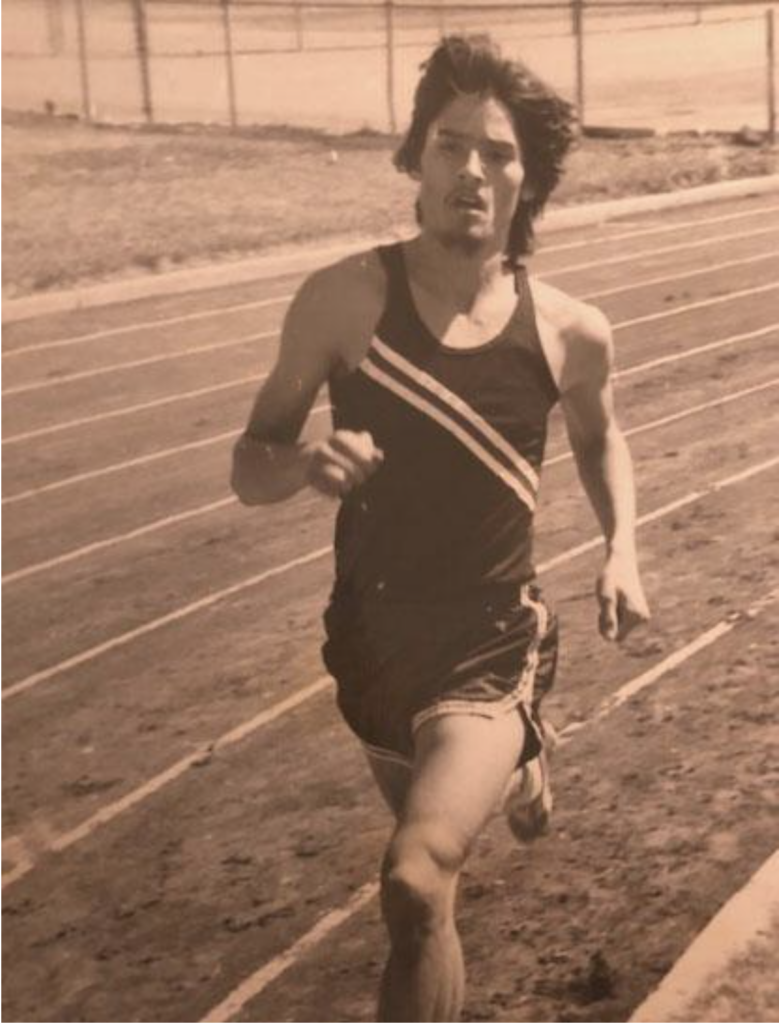
I had to take the Denver public bus to Manual High School because there were no school buses to take us there. I would often get jumped and beaten up by gang members from another school in the back of the bus. From then on I ran to school in the morning and then back home when school was over to survive. Once Billy Mills, the Native American Olympian, came to our high school as a guest speaker to motivate students. He told us about his 10,000 meter gold medal win at the Tokyo Olympics in 1964. He was an inspiration to me. I realized that I could run a race like that too. I joined the track team. I wasn’t that good at the shorter track distances. They were Colorado high school champions in the 100, 200, 400 and 800 meter events. So I became their only miler because no one else on the team wanted to run that distance. My first race was the mile in February 1973 at Fairview High School in Boulder. I placed second with a 4:51 time.
What do you consider your favorite race? Why?
The steeplechase requires speed, strength, endurance and toughness. I ran this event through 1985 and then didn’t race it again until 2001. I placed third in my age group at the steeplechase event at the USATF Masters Track & Field outdoor national championship meet at Iowa State University in Ames, Iowa last July. I ran the first lap and water jump with four other guys. Five of us hit it the water jump at the same time. One of them stepped on my right big toe and broke it. There was blood all over. Now my right toe was broken and left ankle was sprained. I just wanted to quit. But I was sixth place, just held on, and kept getting faster. In the next lap I was in fifth place. In the last lap I focused on catching up to the guy in third place. I passed him at the 200 meter mark just before the water jump and he couldn’t believe it. My last lap was the fastest of anyone, 1:40. I ran a 8:49 race and finished in third place. I then ran a 10K race the next day in honor of Billy Mills.
What is your favorite race distance? What is your personal record (PR) at that distance?
My favorite race distance is the mile with a personal record best time of 4:07. I have now run a sub-five or sub-six minute mile every year for 50 years in a row. It started in 1973 at Boulder’s Fairview High School. For the next 31 years, I annually ran a sub-five minute mile. Since 2004 I have succeeded in running a sub-six minute mile every year in a race. The last time I raced the mile was at Texas Tech’s Jarvis Scott Open indoor meet on February 18 of this year. Jarvis Scott was an Olympic runner and my coach, so I was one of their guests of honor at the meet. I ran 5:54.98 and kept my sub-six minute mile streak alive for another year. I went out too fast with a bunch of younger guys and the rest of the race hung on for my dear life. It was the toughest mile I ever ran.
What are some future running/racing goals?
My racing goals are to 1) continue racing with the BRR Men 60-69 team at the national level; 2) prepare for the steeplechase; 3) race the mile under six minutes for as long as I can; and 4) and keep my nearly 43-year running streak (over 15,600 days) without missing a day, even when sick or hurt. I want to stay with the BRR age group teams as long as I can and race USATF’s Masters track and field and long-distance running events.
What are your thoughts about being a member of the BRR M60+ team?
I love being a member of the M60+ Boulder Road Running team. It’s part of my history from being from Colorado and where my running first started. I don’t want to belong to any other club. I will certainly continue to train smart to stay on the team.
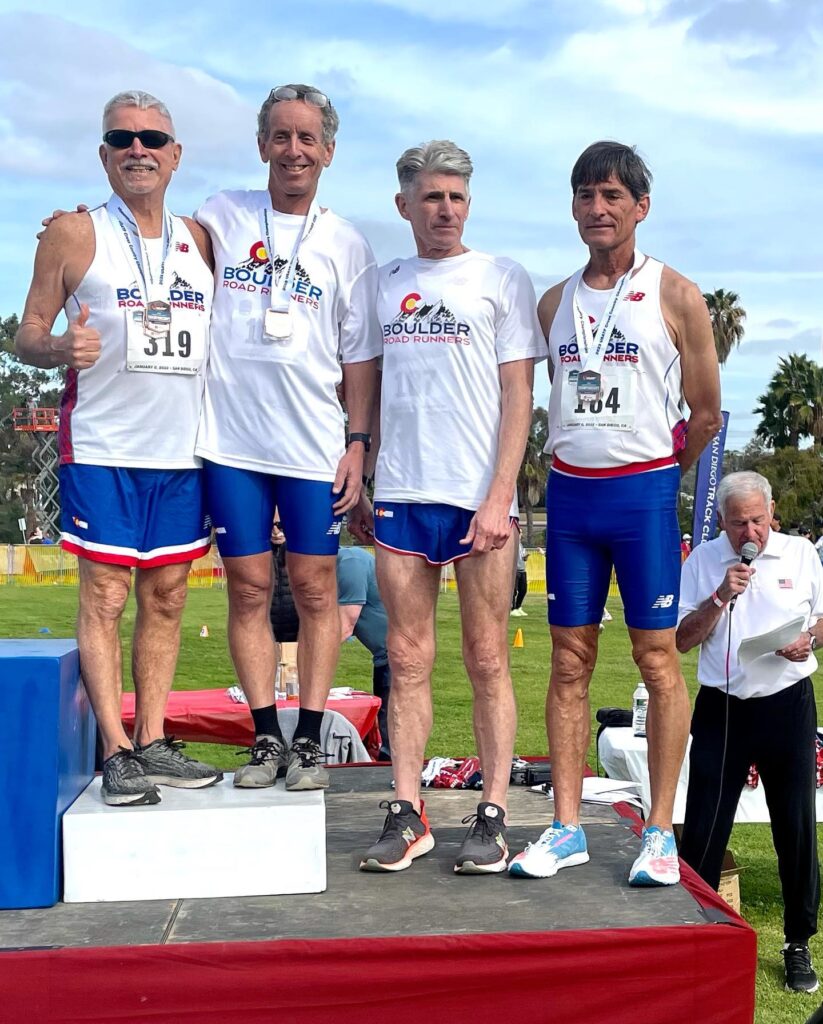
Barros and the Men’s 60+ team makes the podium at the USATF XC Champs in San Diego
Is there anything else that you would like to share with us?
The students I had at Socorro High School in El Paso were primarily Hispanic and the poorest of the poor. When I first started coaching many of these kids smoked pot, drank alcohol, and weren’t very good. But I worked with them. I got rid of the bad kids. I told them that they had to do well academically and taught them how they needed to prepare for college. They got better and I started taking them all over the state of Texas to be seen by college coaches.
Since I had been a college coach I knew what schools were looking for in new recruits. Soon many of the universities wanted my students because they knew they were being trained properly to be excellent college runners. I succeeded in getting many of them university scholarships. Originally, I encouraged them to go to Texas Tech. But soon my student runners told me that they preferred not to go to school there because now they were better able to pick and choose where they went to college. After I retired the colleges were still coming to me for my student runners. I was very fortunate to be able to have helped my runners.